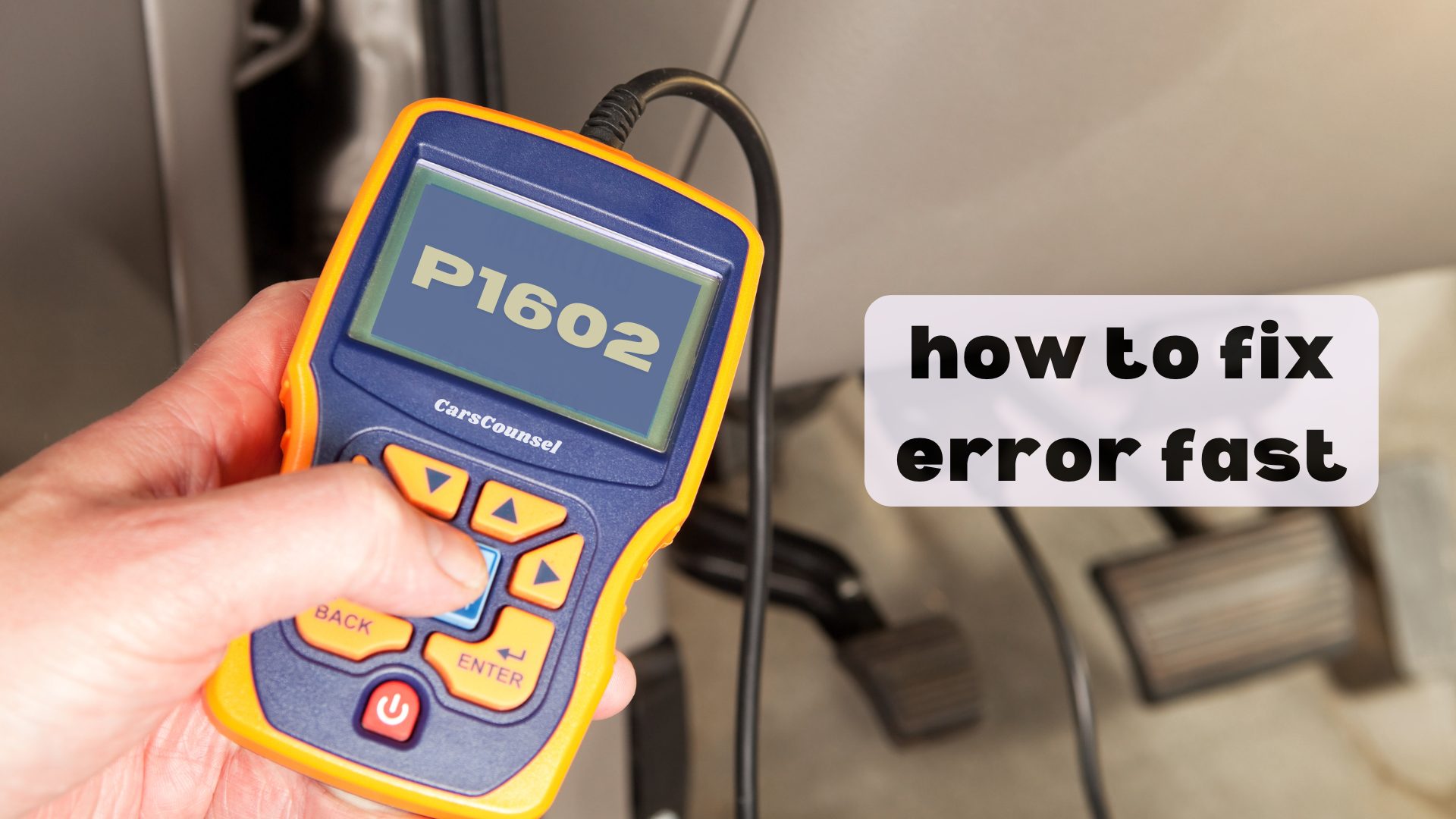
P1602 is a manufacturer-specific powertrain code. Its exact definition depends entirely on the vehicle make, meaning it can indicate a power supply issue, a communication error, or a control module fault.
Because it is manufacturer-specific, the exact application must be verified before diagnosis. This code identifies a detected condition but does not automatically prove a specific internal component has failed.
Quick Navigation
Key Takeaways
- P1602 is a manufacturer-specific code with different meanings depending on the vehicle make and application.
- On VAG applications, it typically indicates a low voltage condition on the Engine Control Module’s Terminal 30 power supply.
- On Ford and Hyundai applications, it often points to a serial communication error between the ECM and the immobilizer or transmission control module.
- Accurate diagnosis requires verifying the exact factory definition for your specific vehicle before testing or replacing any components.
P1602 Code Description and Implications
P1602 is a manufacturer-specific diagnostic trouble code. Because it is not a generic SAE code, its exact definition and the monitored system depend entirely on the manufacturer and application.
Some Volkswagen, Audi, and VAG applications: P1602 indicates a Power Supply (B+) Terminal 30 Low Voltage condition. The Engine Control Module detects that its constant battery power supply has dropped below the expected threshold.
Certain Ford and Hyundai applications: P1602 points to an Immobilizer/ECM Communication Error or a Transmission Control Module (TCM) serial communication problem, preventing the modules from sharing security or shift data.
Specific GM applications: P1602 can indicate a Loss of Electronic Brake Traction Control Module (EBTCM) serial data or a Knock Sensor Module performance fault.
Common Causes of the P1602 Code
Because P1602 applies to entirely different systems depending on the vehicle, the possible causes vary significantly by application.
For VAG applications: A weak or failing vehicle battery, corroded battery terminals, or a blown fuse supplying constant power to the Engine Control Module can trigger the low voltage fault.
For Ford and Hyundai applications: Damaged wiring in the serial communication network, a failing immobilizer antenna ring, or an internal fault in the TCM or ECM can disrupt the data link.
For GM applications: A failing EBTCM, damaged serial data wiring, or a faulty knock sensor module can cause the communication or performance fault.
Symptoms Associated With P1602
Symptoms depend heavily on the specific system and the underlying fault.
On VAG applications, drivers may experience a no-start condition, erratic engine stalling, or the code may simply appear after a recent battery disconnection or jump-start.
On Ford and Hyundai applications, the vehicle may exhibit a no-start condition due to the immobilizer failing to recognize the key, or the transmission may default to a fail-safe shift mode.
On GM applications, the ABS and traction control warning lights may illuminate, or the engine may experience spark knock issues if the knock sensor module is affected.
MIL behavior varies by application. Some vehicles may illuminate the Check Engine Light immediately, while others may store the DTC and trigger specific chassis or security system warnings.
Diagnosing the P1602 Trouble Code
Diagnosis must begin by confirming the exact factory definition and service information for the specific make, model, and engine.
Retrieve the code and record any freeze-frame data or related error codes using a scan tool capable of accessing module communication and live voltage data.
For VAG applications, test the vehicle battery voltage and inspect the fuses and wiring supplying constant Terminal 30 power to the Engine Control Module.
For Ford and Hyundai applications, inspect the serial communication wiring between the ECM, immobilizer, and TCM for opens, shorts, or connector corrosion.
For GM applications, verify the serial data circuit continuity and check the EBTCM or knock sensor module for proper power and ground.
Repairing the P1602 Issue
Repairs must follow the confirmed root cause identified during system-specific testing.
If the battery or charging system is failing on a VAG application, replace the battery and clear the stored memory codes.
If the serial communication wiring is damaged, repair the affected harness section and secure the connections.
If the immobilizer antenna, TCM, EBTCM, or knock sensor module fails testing, replace the confirmed failed component and perform any required module programming or relearn procedures.
Cost Considerations for P1602 Repairs
Repair costs for P1602 vary widely based on the underlying fault, the specific vehicle application, and local labor rates.
Replacing a vehicle battery or repairing a corroded terminal involves minimal to moderate parts costs and standard labor time.
Replacing a control module such as the EBTCM, TCM, or immobilizer antenna involves higher parts costs and requires programming, increasing the total labor time.
Cost depends on diagnostic time, component accessibility, required parts, programming requirements, and labor.
Prevention Strategies for Future Occurrences
Keeping the battery terminals clean and securely tightened can help prevent voltage drops that trigger constant power supply faults on VAG applications.
Protecting exposed wiring harnesses from moisture and road debris can help prevent corrosion that disrupts serial communication networks between control modules.
Troubleshooting Tips and Best Practices
Do not assume a P1602 code requires replacing the Engine Control Module immediately; on many VAG applications, it simply indicates a recent battery disconnection or a weak battery.
On Ford and Hyundai applications, do not ignore related security or transmission codes, as a single break in the serial data line will disable multiple modules simultaneously.
Check for applicable technical service bulletins, as manufacturers occasionally release updated control module software or revised wiring harness pigtails to address chronic communication faults.
More OBD-II Codes
| P1574 | P1580 | P1586 | P1587 |
| P1588 | P1600 | P1603 | P1604 |
| P1605 | P1606 | P1607 | P1608 |
| P1610 | P1611 | P1612 | P1614 |
| P0604 | P0605 | U0100 | U0101 |
| P0600 | P0601 | P0602 | P0603 |
Frequently Asked Questions
Is P1602 a generic or manufacturer-specific code?
No. P1602 is a manufacturer-specific powertrain code. Its exact definition depends on the vehicle make, ranging from power supply faults to communication errors.
Can a P1602 code cause my car not to start?
Yes. On applications where P1602 indicates an immobilizer communication error or a critical ECM power loss, the vehicle will likely experience a no-start condition.
Will P1602 clear itself if I reconnect the battery?
On some VAG applications, P1602 sets simply because the battery was disconnected. However, the stored code usually requires a scan tool to clear before the monitor can reset.
Is it safe to drive with the P1602 code active?
Driving is conditional. If the code indicates an immobilizer fault or a loss of ABS/traction control data, the vehicle may stall or lack critical safety systems, making it unsafe to drive.
Does P1602 mean my ECM is broken?
No. P1602 identifies a detected condition in the power supply or communication circuit. While the ECM can fail, a weak battery or damaged wiring must be ruled out through testing.
What Should You Do About the P1602 Code?
Confirm the exact factory definition and technical service bulletins for your specific vehicle application.
Follow the applicable manufacturer diagnostic procedure to test the relevant power supply circuits, serial communication networks, or control modules based on your vehicle’s specific architecture.
Repair or replace the confirmed failed component, then retest the system to ensure the engine control and security systems operate correctly.

