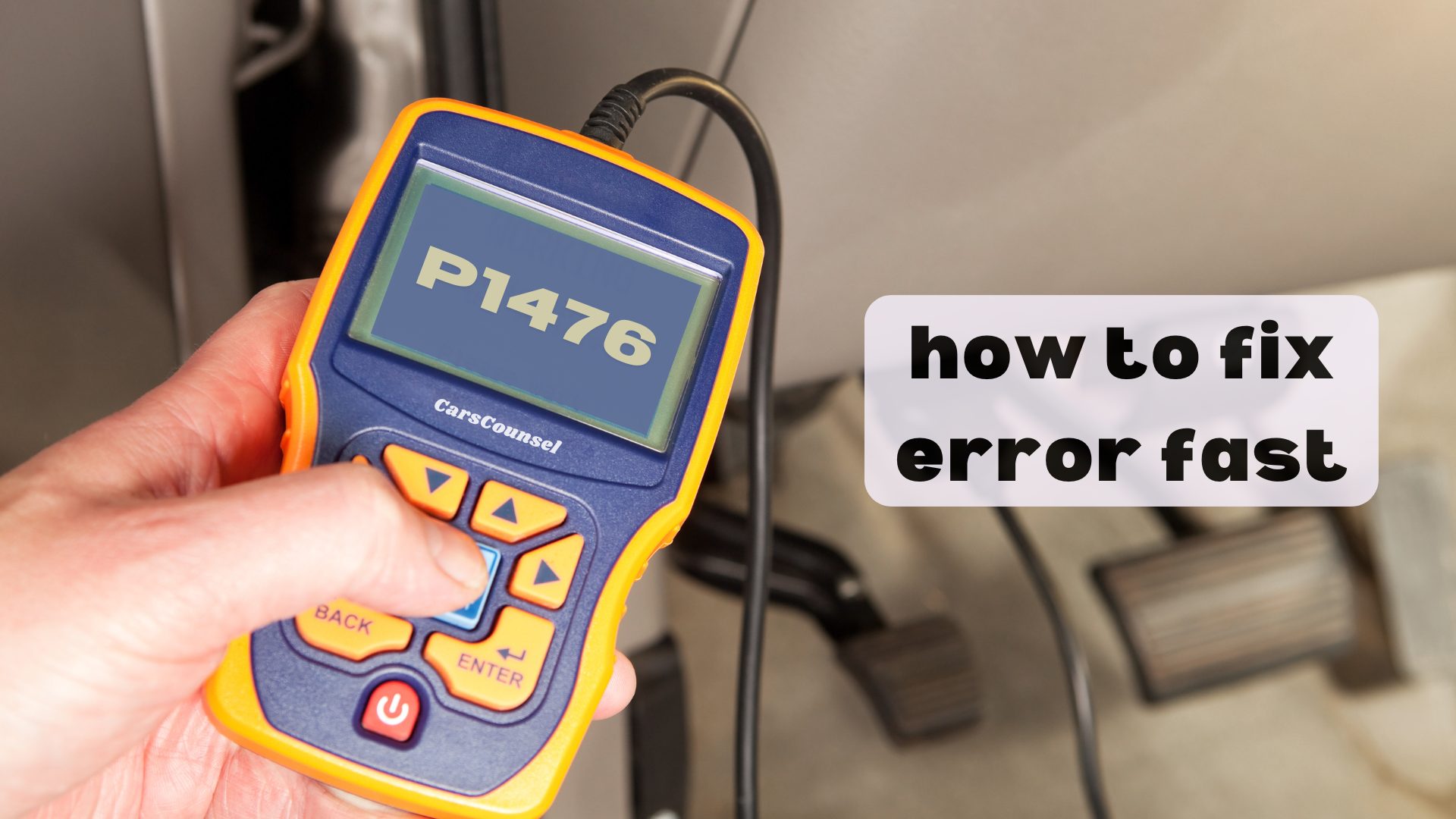
Diagnostic trouble code P1476 is a manufacturer-specific powertrain error code. Because it is manufacturer-specific, its exact definition depends entirely on the vehicle make, model, and application.
Exact vehicle application must be verified before diagnosis. The code identifies a detected condition in a specific subsystem, but further testing is required to identify the root cause.
Quick Navigation
Key Takeaways
- P1476 is a manufacturer-specific code, meaning its definition varies significantly between automakers like Volkswagen, Ford, BMW, and General Motors.
- Possible causes depend on the vehicle and may include EVAP leak detection pump faults, cooling fan relay issues, or intake manifold runner control failures.
- Symptoms vary by application but can include an illuminated Check Engine Light, failed emissions tests, or cooling system concerns.
- Diagnosis requires verifying the exact factory definition for the specific vehicle and following the manufacturer’s targeted testing procedures.
- Repairs depend on the confirmed root cause and may involve replacing a specific relay, repairing vacuum lines, or addressing sensor circuits.
P1476 Code Description and Implications
Because P1476 is manufacturer-specific, there is no single universal definition. The exact monitored system and fault condition depend on the vehicle make and model.
Some Volkswagen, Audi, and BMW applications: P1476 typically indicates an “EVAP Emission Control System Leak Detection Pump (LDP) Malfunction” or “Insufficient Vacuum.” The module detects that the LDP cannot build adequate vacuum to test the fuel system for leaks.
Certain Ford, Mazda, and Jaguar applications: P1476 often designates a “Cooling Fan High Speed Relay Circuit” fault or an “Intake Manifold Runner Control (IMRC)” failure. The module detects an electrical issue in the high-speed fan circuit or a mechanical bind in the intake runners.
Specific General Motors applications: P1476 can indicate an issue with the Exhaust Gas Recirculation (EGR) system or the A/C Refrigerant Pressure Sensor circuit.
Some Dodge/Cummins diesel applications: P1476 may refer to “Too Little Secondary Air” or a cooling fan relay circuit malfunction.
Common Causes of the P1476 Code
The underlying cause depends entirely on the verified factory definition for the specific vehicle application.
For applications monitoring the EVAP Leak Detection Pump, possible causes include a failed LDP diaphragm, disconnected or cracked vacuum lines supplying the pump, or a blocked EVAP vent valve.
For applications monitoring the cooling fan relay, causes often involve a failed high-speed fan relay, damaged wiring to the relay socket, or a seized cooling fan motor drawing excessive current.
For applications monitoring the intake manifold runners or EGR system, causes may include carbon buildup binding the mechanical linkages, a failed actuator motor, or a faulty position sensor.
Symptoms Associated With P1476
Symptoms vary widely depending on the underlying system fault and the vehicle manufacturer.
On applications with an EVAP LDP fault, the primary symptom is an illuminated Check Engine Light and an inability to pass an evaporative emissions test. Drivability is typically unaffected.
On applications with a cooling fan relay fault, the engine may overheat during idle or low-speed driving because the high-speed fan cannot engage.
On applications with an IMRC or EGR fault, the vehicle may experience reduced power, rough idling, or hesitation during acceleration.
Diagnosing the P1476 Trouble Code
Diagnosis must begin by confirming the exact factory definition for the specific make, model, and year. Attempting to diagnose an EVAP leak on a vehicle where P1476 indicates a cooling fan relay will lead to misdiagnosis.
For EVAP LDP applications, technicians typically inspect the vacuum supply lines to the pump, verify that the vent valve is not stuck closed, and test the pump’s electrical circuit and internal diaphragm.
For cooling fan applications, diagnosis involves testing the high-speed relay, checking for voltage and ground at the fan connector, and verifying the fan motor amperage draw.
Repairing the P1476 Issue
Repairs must follow confirmed diagnosis based on the specific vehicle application.
If testing confirms a failed EVAP Leak Detection Pump or cracked vacuum lines, the pump or hoses must be replaced, and the EVAP system must be smoke-tested to verify the repair.
If a cooling fan relay or wiring fault is confirmed, the relay, socket, or damaged wires must be replaced or repaired.
If an IMRC or EGR fault is confirmed, cleaning carbon deposits, replacing the actuator, or repairing the sensor circuit may be required.
Cost Considerations for P1476 Repairs
Repair costs depend entirely on the confirmed root cause, component accessibility, and local labor rates.
Replacing an external relay or a section of vacuum hose may require minimal parts and labor. Conversely, replacing an integrated Leak Detection Pump or diagnosing complex intake manifold runner mechanisms requires more diagnostic time and specialized components.
Prevention Strategies for Future Occurrences
Some electrical or mechanical failures cannot be reliably prevented. However, inspecting underhood vacuum lines for brittleness or cracking can help prevent EVAP LDP vacuum supply issues.
Ensuring that cooling fan relays and electrical connectors remain free of moisture and corrosion can help reduce the likelihood of fan circuit faults.
Troubleshooting Tips and Best Practices
Never assume P1476 is a universal emissions or particulate sensor code. Always verify the exact definition for the specific vehicle before purchasing parts or beginning electrical testing.
Do not ignore related codes. An EVAP LDP fault may appear alongside other EVAP leak codes, while a cooling fan fault may trigger engine overtemperature warnings or related fan circuit codes.
Check for technical service bulletins applicable to your exact vehicle application, as manufacturers frequently release updated relays, revised vacuum line routing, or software recalibrations for recurring faults.
More OBD-II Codes
| P1475 | P1478 | P0440 | P0420 |
| P1457 | P1479 | P0442 | P0430 |
| P1456 | P1480 | P0455 | P0171 |
| P1449 | P1481 | P0456 | P0174 |
| P1448 | P1482 | P0446 | P0300 |
| P1447 | P1483 | P0441 | P0301 |
Frequently Asked Questions
Is P1476 a generic or manufacturer-specific code?
No. P1476 is a manufacturer-specific code. Its exact definition varies significantly between automakers, so the factory service information for the specific vehicle must be consulted.
Can I drive my car with a P1476 code?
It depends on the application. If P1476 indicates a cooling fan relay fault, driving could cause engine overheating. If it indicates an EVAP fault, the vehicle is usually safe to drive but will fail emissions tests.
Will disconnecting the battery clear the P1476 code?
Disconnecting the battery may temporarily clear the code, but it does not repair the underlying electrical or mechanical fault. The code will return once the module runs its self-test.
Can a loose gas cap cause a P1476 code?
On applications where P1476 indicates an EVAP Leak Detection Pump fault, a loose gas cap can cause EVAP system errors, though it typically triggers specific leak codes like P0455 or P0456 alongside it.
Does P1476 always mean the engine control module is bad?
No. While a failing module can cause circuit faults, failed relays, cracked vacuum lines, or mechanical binding in the intake or EVAP systems are frequent causes that must be ruled out first.
What Should You Do About the P1476 Code?
Confirm the exact factory definition and diagnostic procedure for your specific vehicle application. Because P1476 is manufacturer-specific, identifying whether it relates to the EVAP system, cooling fans, or intake runners is the mandatory first step.
Follow the applicable manufacturer diagnostic steps to test the relevant system and components. Once the root cause is confirmed, complete the necessary repairs and verify that the system operates correctly and the code does not return.

