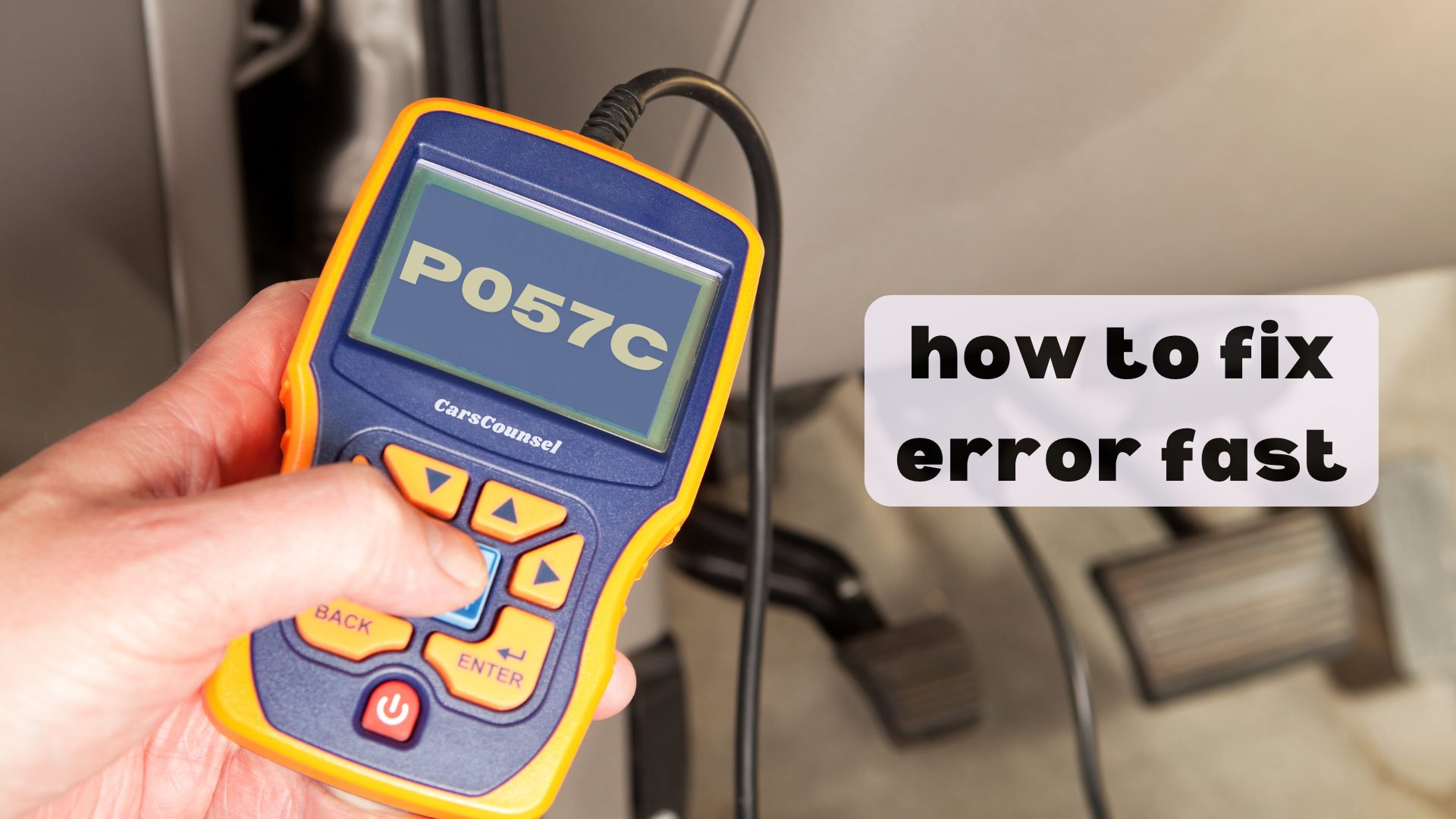
P057C is a generic OBD-II powertrain code defined as “Brake Pedal Position Sensor ‘A’ Circuit Low.” It applies across various vehicle manufacturers equipped with electronic brake pedal position sensors.
This code indicates the control module detected a voltage signal below the expected range on the sensor circuit. It does not automatically prove the sensor has failed.
Quick Navigation
Key Takeaways
- P057C indicates a low voltage condition or open circuit in the Brake Pedal Position Sensor “A” circuit.
- Possible causes include a misadjusted sensor, damaged wiring, or a poor electrical connection.
- Diagnosis requires inspecting the sensor adjustment, testing the circuit voltage, and checking for related stability control codes.
- Repairs range from recalibrating the sensor to replacing the confirmed failed sensor or repairing damaged wiring.
P057C Code Description and Implications
P057C is a generic OBD-II diagnostic trouble code. It indicates that the powertrain control module (PCM) or related chassis module has detected an abnormally low voltage signal on the Brake Pedal Position (BPP) Sensor “A” circuit.
The BPP sensor tells the vehicle’s computers when the brake pedal is pressed. This data is used for cruise control cancellation, shift interlocks, and stability control systems.
When the signal drops below the minimum threshold, the module sets P057C and may disable cruise control or trigger a stability control warning message.
Common Causes of the P057C Code
Because P057C monitors the electrical signal from the brake pedal assembly, the root cause involves the sensor circuit or its physical adjustment.
A misadjusted or improperly installed brake pedal position sensor is a possible cause, resulting in an out-of-range signal when the pedal is released.
A failed BPP sensor internally shorting or sending a constant low signal can also trigger this code.
Damaged, chafed, or broken wiring in the sensor harness, or a poor ground connection, can interrupt the signal path.
Corroded or loose electrical connectors at the sensor or the control module can also cause a low voltage reading.
Symptoms Associated With P057C
The most consistent symptom is an illuminated Check Engine Light, often accompanied by an ABS or stability control warning message on the dashboard.
Drivers may notice that the cruise control fails to engage or disengages unexpectedly while driving.
The brake lights may stay on continuously or fail to illuminate, and the shift interlock may prevent the vehicle from shifting out of Park.
MIL behavior varies by application. Some vehicles may illuminate the Check Engine Light immediately, while others may store the DTC and trigger specific chassis system warnings.
Diagnosing the P057C Trouble Code
Diagnosis must begin by confirming the exact factory definition and service information for the specific make, model, and engine.
Retrieve the code and record any freeze-frame data or related error codes using a scan tool capable of monitoring BPP sensor live data.
Visually inspect the brake pedal position sensor for proper physical adjustment and mounting clearance against the pedal arm.
Check the wiring harness and connectors for damage, corrosion, or loose pins.
Use a multimeter to verify the reference voltage, ground, and signal circuits at the sensor connector according to manufacturer specifications.
Repairing the P057C Issue
Repairs must follow the confirmed root cause identified during electrical and mechanical testing.
If the sensor is misadjusted, adjust it to the manufacturer’s specified clearance and perform a relearn procedure if required by the vehicle.
If wiring damage or connector corrosion is found, repair or replace the affected harness section and secure the connections.
If the sensor fails electrical testing or cannot be calibrated, replace the confirmed failed brake pedal position sensor.
Clear the codes and test drive the vehicle to verify the repair and ensure cruise control and stability systems function correctly.
Cost Considerations for P057C Repairs
Repair costs for P057C vary based on the underlying fault, vehicle accessibility, and local labor rates.
Adjusting an existing sensor or performing a software relearn involves minimal parts cost and standard diagnostic labor.
Replacing the BPP sensor involves standard parts costs and minimal labor, as it is typically located near the brake pedal arm under the dashboard.
Cost depends on diagnostic time, component accessibility, required parts, programming requirements, and labor.
Prevention Strategies for Future Occurrences
Avoiding excessive force or improper positioning of aftermarket floor mats can help prevent the brake pedal from binding or interfering with the sensor mechanism.
Keeping the under-dash area dry and free of debris helps protect the sensor connectors from moisture intrusion and corrosion.
Troubleshooting Tips and Best Practices
Do not assume a P057C code requires immediately replacing the brake pedal position sensor; on many applications, the sensor simply requires a physical adjustment or a software relearn procedure.
Always check for related ABS or chassis codes, as the BPP sensor data is shared across multiple vehicle networks and a single fault can trigger multiple warning lights.
Check for applicable technical service bulletins, as manufacturers occasionally release updated sensor part numbers, revised mounting brackets, or module software recalibrations to address chronic low-voltage signal faults.
More OBD-II Codes
| P0551 | P0556 | P0560 | P0571 |
| P0572 | P0573 | P0581 | P0597 |
| P0600 | P0601 | P0602 | P0603 |
| P0504 | P0501 | P0703 | P0500 |
| P0171 | P0300 | P0420 | P0430 |
| P0174 | P0442 | P0455 | P0172 |
Frequently Asked Questions
Is P057C a generic or manufacturer-specific code?
Yes. P057C is a generic OBD-II code standardized by SAE. It carries the same basic definition across manufacturers, though exact diagnostic procedures vary by application.
Can a P057C code affect my vehicle’s cruise control?
Yes. The PCM uses the BPP sensor signal to cancel cruise control when the brakes are applied. A low circuit fault will typically disable the cruise control system entirely.
Will P057C clear itself if I adjust the brake pedal sensor?
Not automatically. While adjusting the sensor may resolve the underlying cause, the stored code usually requires a scan tool to clear before the monitor can reset.
Is it safe to drive with the P057C code active?
The vehicle is usually safe to drive to a repair facility. However, you may lose cruise control functionality and experience issues with the shift interlock or stability control systems.
Does P057C mean my brake pads are worn out?
No. P057C identifies an electrical fault in the brake pedal position sensor circuit. It does not monitor the physical thickness or wear condition of the brake pads or rotors.
What Should You Do About the P057C Code?
Confirm the exact factory definition and diagnostic procedure for your specific vehicle application.
Follow the applicable manufacturer diagnostic sequence to test the brake pedal position sensor circuit, physical adjustment, and related chassis networks.
Repair or replace the confirmed failed component, then retest the system to ensure the brake lights, cruise control, and stability systems operate correctly.

