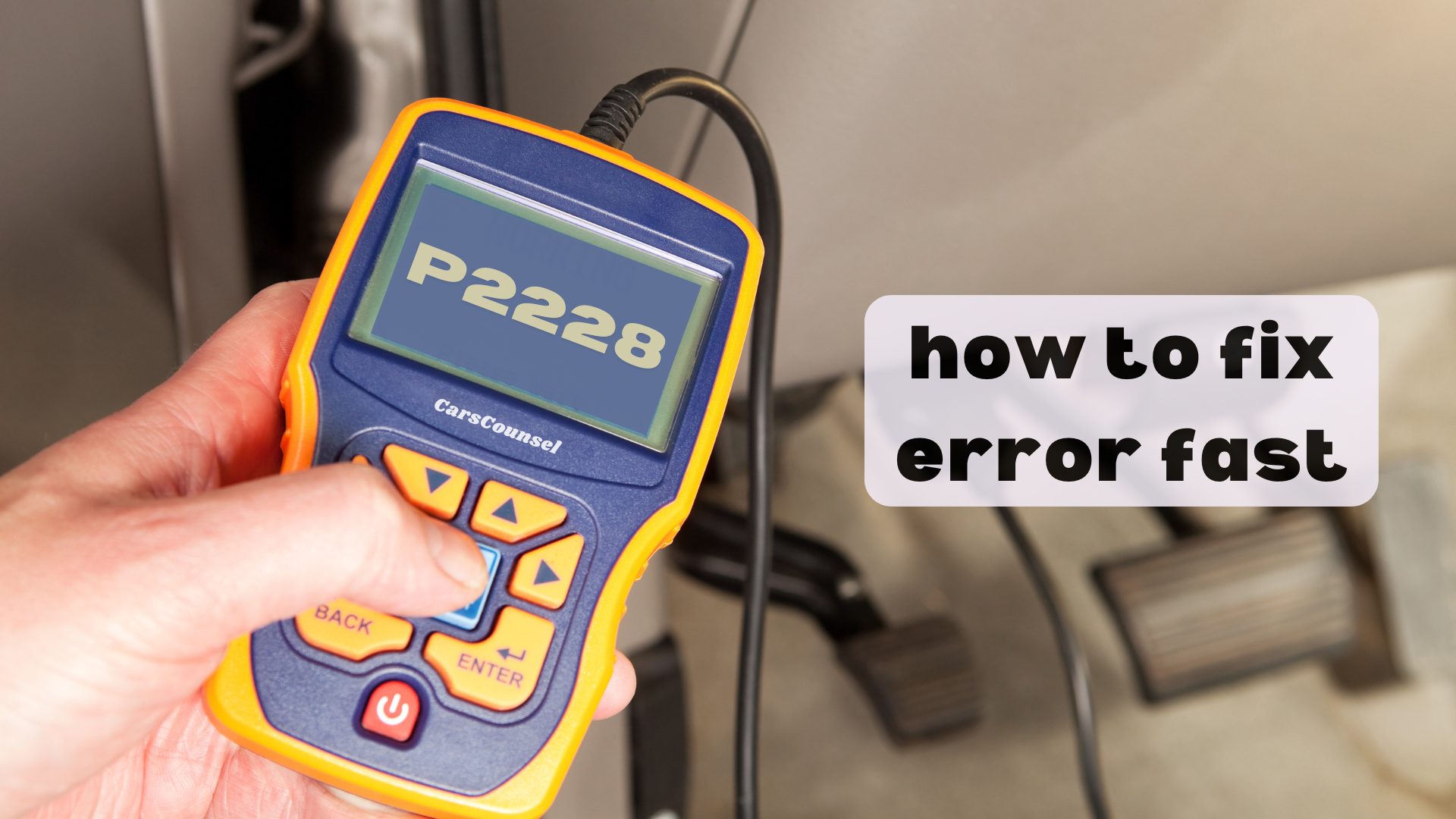
The P2228 code is a generic OBD-II powertrain code indicating a “Barometric Pressure Sensor ‘A’ Circuit Low” condition. The control module detects that the signal voltage from the barometric pressure sensor circuit is below the expected minimum threshold.
This code identifies an electrical circuit condition and does not automatically prove the sensor has failed. Proper diagnosis requires verifying the exact vehicle application, inspecting wiring, and testing the sensor circuits before replacing components.
Quick Navigation
Key Takeaways
- P2228 indicates the control module detected a low voltage signal from the barometric pressure sensor “A” circuit.
- The code flags an electrical condition, which does not automatically confirm a failed barometric pressure sensor.
- Damaged wiring, corroded connectors, or a short to ground are frequent causes to verify before replacing components.
- Diagnosis requires testing the sensor reference voltage, signal circuit, and ground before authorizing part replacement.
P2228 Code Description and Implications
The P2228 code stands for “Barometric Pressure Sensor ‘A’ Circuit Low.” The powertrain control module (PCM) uses the barometric pressure (BARO) sensor to measure ambient atmospheric pressure, which helps calculate air density for precise fuel delivery and ignition timing.
Depending on the vehicle architecture, the BARO sensor may be a standalone component, integrated into the mass airflow (MAF) sensor, or built directly into the PCM.
If the module detects that the signal voltage from the BARO sensor circuit drops below the minimum threshold, it stores the P2228 code.
Common Causes of the P2228 Code
Several electrical and mechanical conditions can cause the control module to detect a low voltage fault in the barometric pressure sensor circuit.
- Short to ground: The signal wire between the sensor and the PCM may be shorted to ground, pulling the voltage near zero.
- Faulty BARO sensor: The internal sensor element may have failed, sending a continuously low voltage signal.
- Wiring and connector issues: Chafed wires, broken harnesses, or corroded connector pins in the sensor circuit.
- Poor electrical grounds: A corroded or loose ground connection for the sensor or the PCM.
- PCM failure: If the BARO sensor is internal to the PCM, an internal module fault may cause the circuit low reading.
Symptoms Associated With P2228
Because P2228 relates to air density calculations, symptoms can affect engine efficiency and drivability.
- Illuminated Check Engine Light: The MIL will activate once the module confirms the circuit malfunction.
- Poor engine performance: Incorrect air density data can cause hesitation, rough idle, or sluggish acceleration.
- Decreased fuel economy: The PCM may enrich the fuel mixture unnecessarily if it misreads atmospheric pressure.
- No drivability issues: In some applications, the vehicle may run normally despite the stored code and warning light.
Diagnosing the P2228 Trouble Code
Accurate diagnosis requires distinguishing between an electrical circuit fault and a failed sensor or module.
- Verify the exact application: Determine whether the vehicle uses a standalone BARO sensor, a MAF-integrated sensor, or an internal PCM sensor.
- Review live data: Use a scan tool to monitor the BARO sensor data at key-on, engine-off (KOEO) and compare it to a known absolute pressure reference.
- Inspect the wiring and connectors: Visually examine the sensor harness for damage, heat exposure, or corrosion.
- Test the sensor circuit: Measure the reference voltage, signal circuit continuity, and ground connections according to the manufacturer wiring diagram.
- Evaluate the PCM: If the sensor is internal and external circuits are not applicable, follow the manufacturer procedure to diagnose the PCM.
Repairing the P2228 Issue
Repairs must address the specific root cause identified during diagnosis. Clearing the code without fixing the underlying condition will result in its return.
- Wiring repair: Repair or replace any damaged wiring, clean corroded connector terminals, and secure loose grounds.
- Sensor replacement: If electrical tests confirm a standalone or MAF-integrated sensor has failed, replace the component.
- Module diagnosis: If the BARO sensor is internal to the PCM and the module is confirmed faulty, follow the applicable PCM service or replacement procedure.
Cost Considerations for P2228 Repairs
Repair costs for a P2228 code vary significantly based on the underlying cause and the vehicle’s design.
- Wiring repair: Costs depend on the time required to trace the harness and perform a proper repair.
- Sensor replacement: Moderate cost, depending on whether a standalone sensor or a complete MAF sensor assembly is required.
- PCM replacement: If the sensor is internal and the module has failed, the repair involves substantial parts cost and programming requirements.
Prevention Strategies for Future Occurrences
Protecting the engine’s electrical harnesses reduces the likelihood of sensor circuit faults.
- Protect engine wiring: Ensure sensor harnesses are routed away from extreme heat sources like exhaust manifolds to prevent insulation melting.
- Keep connectors sealed: Verify that sensor connector seals are intact to prevent moisture intrusion and terminal corrosion.
- Inspect exposed wiring: Checking exposed wiring can help identify developing damage before it causes a short to ground.
Troubleshooting Tips and Best Practices
When addressing a P2228 code, avoid common diagnostic shortcuts that lead to unnecessary parts replacement.
- Never use weather apps for diagnosis: Consumer weather apps report sea-level-corrected pressure, not absolute atmospheric pressure. Use an appropriate absolute-pressure reference or compare to the MAP sensor at KOEO.
- Check for Technical Service Bulletins (TSBs): Some manufacturers issue updated sensor part numbers or software calibrations for specific models prone to barometric pressure codes.
- Review related faults: If multiple fuel trim or air metering codes are present, review other OBD2 Codes to identify a shared reference voltage or ground issue.
- Avoid parts-cannon diagnosis: Do not replace the PCM without verifying the applicable reference, signal, and ground circuits first.
More OBD-II Codes
| P2227 | P2200 | P2104 | P2103 |
| P2102 | P2101 | P2229 | P2237 |
| P2238 | P2261 | P2262 | P2263 |
| P2099 | P2098 | P2097 | P2096 |
| P2401 | P2402 | P2404 | P2407 |
| P2088 | P2080 | P2078 | P2076 |
Frequently Asked Questions
Is P2228 a generic or manufacturer-specific code?
Yes, P2228 is a generic OBD-II code. Its definition regarding the barometric pressure sensor circuit low is standardized across all vehicle manufacturers, though specific sensor locations vary.
Can I drive my car with a P2228 code?
Driving is generally possible, but you may experience reduced fuel economy or poor engine performance. Have the electrical circuit diagnosed promptly to prevent further drivability issues.
Will replacing the MAF sensor fix the P2228 code?
On some applications, the barometric pressure sensor is integrated into the mass airflow (MAF) sensor. If testing confirms the integrated sensor has failed, replacing the MAF assembly is required.
Does P2228 mean my PCM is bad?
Not necessarily. While some vehicles feature an internal BARO sensor within the PCM, the code frequently points to a simple wiring issue, corroded connector, or failed standalone sensor. Proper circuit testing is required.
Can extreme weather cause a P2228 code?
No. While the BARO sensor measures atmospheric pressure, extreme weather or altitude changes alter the pressure reading, not the circuit voltage. P2228 specifically indicates an electrical fault, such as a short to ground.
What Should You Do About the P2228 Code?
When the P2228 code appears, your first step should be to inspect the barometric pressure sensor wiring and connectors for visible damage or corrosion. Do not ignore poor engine performance or decreased fuel economy.
Confirm the exact factory definition and diagnostic procedure for your specific vehicle application. Have a qualified technician verify the sensor signal and test the relevant system and components before authorizing major repairs.

