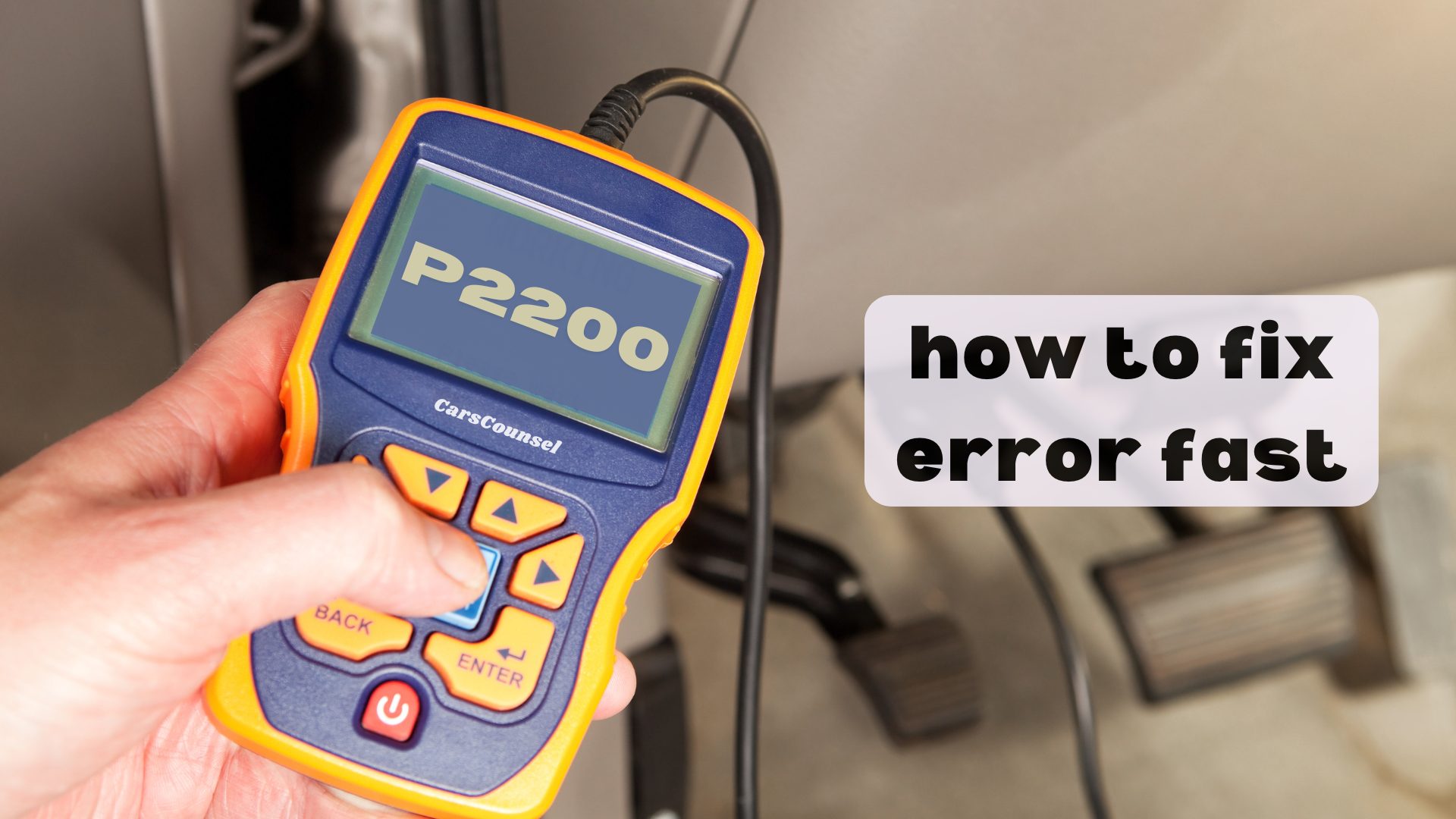
P2200 is a generic OBD-II powertrain code defined as “NOx Sensor Circuit Bank 1.” It applies to vehicles equipped with nitrogen oxide monitoring systems.
This code indicates the powertrain control module detected an electrical fault or abnormal signal in the Bank 1 NOx sensor circuit. It does not automatically prove the sensor has failed.
Quick Navigation
Key Takeaways
- P2200 indicates an electrical or communication fault in the NOx sensor circuit for Bank 1.
- Possible causes include a failed NOx sensor, damaged wiring, exhaust leaks, or connector corrosion.
- Diagnosis requires inspecting the sensor circuit and testing the sensor signal before replacing parts.
- Repairs range from repairing damaged wiring to replacing the confirmed failed NOx sensor module.
P2200 Code Description and Implications
P2200 is a generic OBD-II diagnostic trouble code. It indicates that the powertrain control module (PCM) has detected an electrical fault or abnormal signal in the Nitrogen Oxide (NOx) sensor circuit on Bank 1.
NOx sensors are primarily used on diesel applications equipped with Selective Catalytic Reduction (SCR) systems, as well as some advanced gasoline engines. Bank 1 refers to the engine bank that contains cylinder number one.
When the PCM detects an open circuit, short, or implausible signal from the sensor, it sets P2200. This condition prevents the emissions control system from accurately monitoring and reducing nitrogen oxide output.
Common Causes of the P2200 Code
Because P2200 monitors the electrical integrity and signal plausibility of the NOx sensor circuit, the root cause usually involves the sensor itself or its wiring.
A failed NOx sensor module is a possible cause. These sensors operate in harsh exhaust environments and can degrade or fail internally over time.
Damaged, chafed, or melted wiring in the harness connecting the sensor to the PCM can interrupt the signal or cause a short circuit.
Corroded or loose electrical connectors at the sensor pigtail can disrupt communication.
Exhaust leaks upstream of or near the NOx sensor can introduce outside air, causing the sensor to read implausible data and trigger a circuit or plausibility code.
Symptoms Associated With P2200
The most consistent symptom is an illuminated Check Engine Light or a specific emissions system warning message on the dashboard.
On diesel applications with SCR systems, the vehicle may enter a reduced power limp mode or display a countdown to restricted starts if the emissions fault is not resolved.
Fuel economy and drivability may remain unaffected in the short term, as the NOx sensor primarily monitors the exhaust rather than controlling immediate fuel delivery.
MIL behavior varies by application. Some vehicles may illuminate the Check Engine Light immediately, while others may require multiple drive cycles to set the code.
Diagnosing the P2200 Trouble Code
Diagnosis must begin by confirming the exact factory definition and service information for the specific make, model, and engine.
Retrieve the code and record any freeze-frame data or related error codes using a scan tool capable of displaying live NOx sensor data and DEF system parameters.
Visually inspect the NOx sensor wiring harness and connector for heat damage, chafing against the exhaust, or corrosion.
If the wiring is intact, use a multimeter or oscilloscope to test the sensor’s power, ground, and communication circuits according to the manufacturer’s pinpoint tests.
Check for exhaust leaks near the sensor bung, as false air intrusion can cause the sensor to report out-of-range values.
Repairing the P2200 Issue
Repairs must follow the confirmed root cause identified during electrical and mechanical testing.
If the wiring harness is damaged, repair or replace the affected section and secure it away from hot exhaust components.
If the connector is corroded, clean the terminals or replace the pigtail connector.
If the NOx sensor fails the manufacturer’s electrical tests or reports implausible data with no exhaust leaks present, replace the confirmed failed NOx sensor module.
After replacing the sensor, some applications require a scan tool to perform an adaptation or reset procedure for the new sensor module.
Cost Considerations for P2200 Repairs
Repair costs for P2200 vary based on the underlying fault, vehicle accessibility, and local labor rates.
Repairing damaged wiring involves minimal parts costs and moderate labor time depending on harness routing.
Replacing a NOx sensor involves higher parts costs, as these are complex electrochemical modules, and labor time varies based on sensor location in the exhaust stream.
Cost depends on diagnostic time, component accessibility, required parts, programming requirements, and labor.
Prevention Strategies for Future Occurrences
Keeping the exhaust system free of major leaks helps ensure the NOx sensor reads accurate exhaust gas concentrations without false air intrusion.
Protecting the sensor wiring harness from excessive heat and road debris can help prevent premature electrical faults.
Troubleshooting Tips and Best Practices
Do not assume a P2200 code requires replacing the NOx sensor immediately; wiring damage and connector corrosion are frequent culprits in harsh undercarriage environments.
Always check for related SCR or DEF system codes, as a failure in the reductant delivery system can sometimes cause secondary NOx sensor plausibility faults.
Check for applicable technical service bulletins, as manufacturers occasionally release updated NOx sensor part numbers, revised wiring harness pigtails, or PCM software recalibrations to address chronic sensor circuit faults.
More OBD-II Codes
| P2099 | P2098 | P2097 | P2096 |
| P2088 | P2080 | P2227 | P2228 |
| P2229 | P2237 | P2238 | P2261 |
| P2048 | P2005 | P2431 | P0420 |
| P0430 | P2002 | P2004 | P2401 |
| P2015 | P2006 | P2007 | P2008 |
Frequently Asked Questions
Is P2200 a generic or manufacturer-specific code?
Yes. P2200 is a generic OBD-II code standardized by SAE. It carries the same basic definition across manufacturers, though exact diagnostic procedures vary by application.
Can a P2200 code cause my vehicle to enter limp mode?
Yes. On many modern diesel applications with SCR systems, a critical NOx sensor circuit fault can trigger a reduced power limp mode or a restricted engine start countdown.
Will P2200 clear itself if I fix an exhaust leak?
Not automatically. While repairing an exhaust leak may resolve the underlying cause, the stored code usually requires a scan tool to clear before the monitor can reset.
Is it safe to drive with the P2200 code active?
The vehicle is usually safe to drive to a repair facility. However, on diesel applications, ignoring the code may eventually lead to severe speed restrictions or a no-start condition.
Does P2200 mean my catalytic converter is bad?
No. P2200 specifically identifies an electrical or signal fault in the NOx sensor circuit. While a failing catalyst can cause efficiency codes, P2200 points to the sensor circuit itself.
What Should You Do About the P2200 Code?
Confirm the exact factory definition and diagnostic procedure for your specific vehicle application.
Follow the applicable manufacturer diagnostic sequence to test the NOx sensor circuit, wiring, and exhaust integrity.
Repair or replace the confirmed failed component, then retest the system to ensure the emissions monitor completes successfully.

