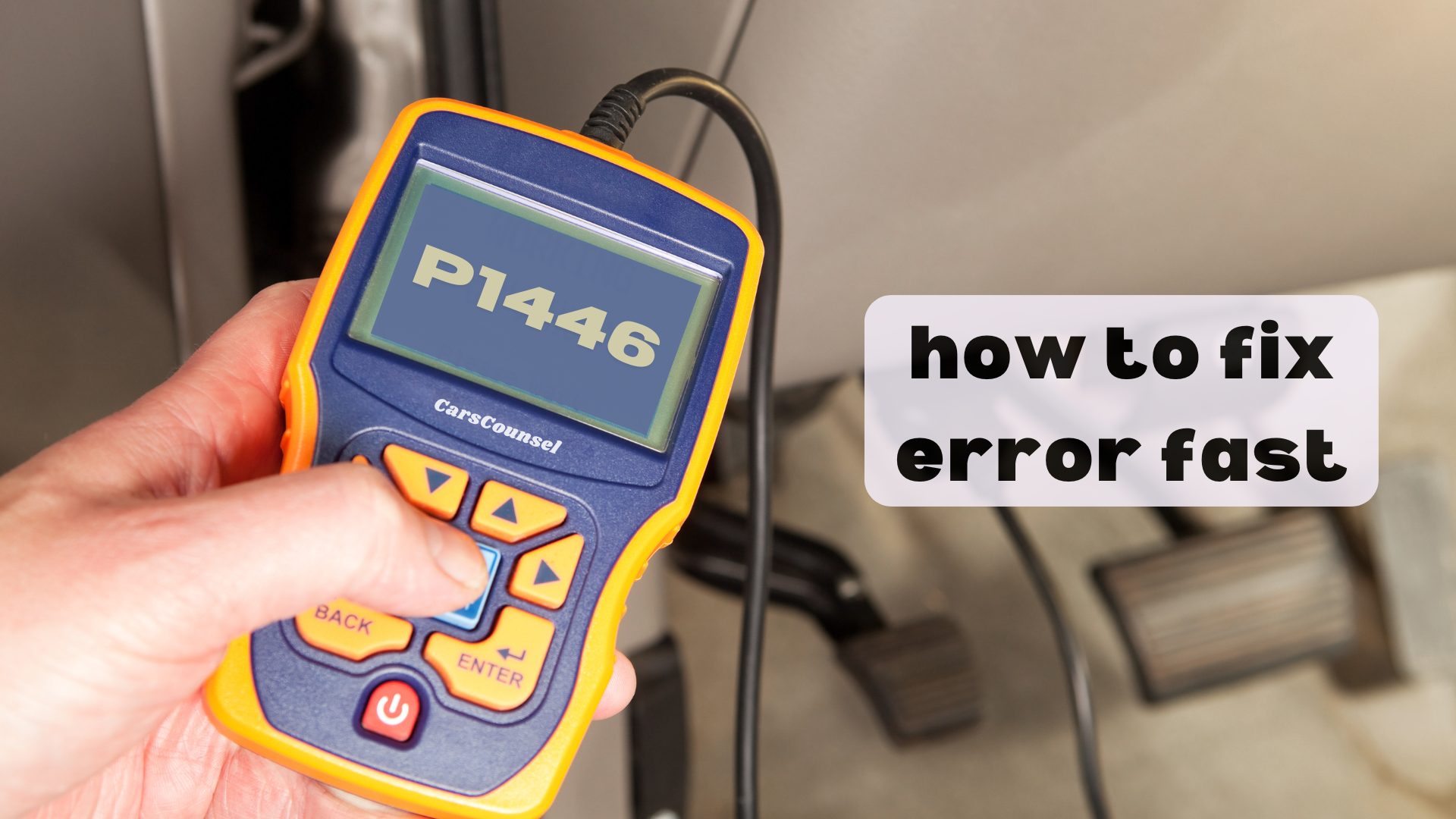
Diagnostic trouble code P1446 is a manufacturer-specific powertrain error code. Because it is manufacturer-specific, its exact definition depends entirely on the vehicle make, model, and application.
Exact vehicle application must be verified before diagnosis. The code identifies a detected condition in a specific subsystem, but further testing is required to identify the root cause.
Quick Navigation
Key Takeaways
- P1446 is a manufacturer-specific code, meaning its definition varies significantly between automakers like Nissan, Volkswagen, and Honda.
- Possible causes depend on the vehicle and may include EVAP vent valve faults, catalyst temperature sensor issues, or hybrid battery module deviations.
- Symptoms vary by application but can include an illuminated Check Engine Light, difficulty refueling, or hybrid system warnings.
- Diagnosis requires verifying the exact factory definition for the specific vehicle and following the manufacturer’s targeted testing procedures.
- Repairs depend on the confirmed root cause and may involve replacing a specific valve, sensor, or addressing hybrid battery concerns.
P1446 Code Description and Implications
Because P1446 is manufacturer-specific, there is no single universal definition. The exact monitored system and fault condition depend on the vehicle make and model.
Some Nissan and Infiniti applications: P1446 typically indicates an “EVAP Canister Vent Control Valve” fault, specifically that the valve is stuck closed.
Certain Volkswagen applications: P1446 often designates a “Catalyst Temperature Circuit Short To Ground” fault.
Specific Honda hybrid applications: P1446 can indicate a “Battery Module Individual Voltage Input Deviation,” pointing to an IMA battery cell imbalance.
Common Causes of the P1446 Code
The underlying cause depends entirely on the verified factory definition for the specific vehicle application.
For applications monitoring the EVAP vent valve, possible causes include a failed valve solenoid mechanically stuck in the closed position, damaged wiring, or severe corrosion inside the electrical connector.
For applications monitoring the catalyst temperature sensor, causes often involve a failed sensor element, chafed wiring near the hot exhaust, or a poor ground circuit.
For hybrid applications monitoring battery modules, causes may include degraded hybrid battery cells, failing battery management sensors, or high-voltage wiring issues.
Symptoms Associated With P1446
Symptoms vary widely depending on the underlying system fault and the vehicle manufacturer.
On applications with an EVAP vent valve stuck closed, the primary symptom is difficulty refueling, as the fuel pump prematurely shuts off due to trapped tank pressure.
On applications with a catalyst temperature sensor fault, the vehicle may experience reduced power or fail an emissions inspection due to incomplete monitor readiness.
On hybrid applications, the driver may see an IMA system warning light, reduced fuel economy, or the vehicle entering a fail-safe mode.
Diagnosing the P1446 Trouble Code
Diagnosis must begin by confirming the exact factory definition for the specific make, model, and year. Attempting to diagnose an EVAP leak on a hybrid where P1446 indicates a battery cell deviation will lead to misdiagnosis.
For EVAP applications, technicians typically command the vent valve open using a bidirectional scan tool and monitor the fuel tank pressure sensor to verify the valve is no longer stuck closed.
For catalyst sensor applications, diagnosis involves checking the sensor reference voltage, signal circuit, and ground, while comparing live data to expected exhaust temperatures.
Repairing the P1446 Issue
Repairs must follow confirmed diagnosis based on the specific vehicle application.
If testing confirms a failed EVAP canister vent control valve or damaged wiring, the valve or harness must be replaced, and the EVAP system must be tested to verify proper venting during refueling.
If a catalyst temperature sensor or wiring fault is confirmed, the sensor or damaged wires must be replaced using high-temperature materials.
If a hybrid battery module deviation is confirmed, reconditioning the battery pack, replacing individual modules, or replacing the entire high-voltage battery may be required.
Cost Considerations for P1446 Repairs
Repair costs depend entirely on the confirmed root cause, component accessibility, and local labor rates.
Replacing an external EVAP vent valve or a temperature sensor may require minimal parts and labor. Conversely, addressing hybrid battery module deviations requires specialized high-voltage equipment and significant labor.
Prevention Strategies for Future Occurrences
Some electrical or mechanical failures cannot be reliably prevented. However, inspecting underbody EVAP components and wiring for physical damage or road debris impact can help prevent vent valve circuit issues.
For hybrid applications, maintaining the battery cooling system and avoiding extreme state-of-charge depletion helps prolong battery module life.
Troubleshooting Tips and Best Practices
Never assume P1446 is a universal EVAP code. Always verify the exact definition for the specific vehicle before purchasing parts or beginning electrical testing.
Do not ignore related codes. An EVAP vent valve fault frequently appears alongside difficulty refueling complaints, while hybrid battery faults may trigger other high-voltage system warnings.
Check for technical service bulletins applicable to your exact vehicle application, as manufacturers frequently release updated valves, revised wiring harnesses, or software recalibrations for recurring faults.
More OBD-II Codes
| P1433 | P1447 | P0440 | P0420 |
| P1431 | P1448 | P0441 | P0430 |
| P1423 | P1449 | P0442 | P0171 |
| P1421 | P1475 | P0446 | P0174 |
| P1420 | P1476 | P0455 | P0300 |
| P1418 | P1479 | P0456 | P0301 |
Frequently Asked Questions
Is P1446 a generic or manufacturer-specific code?
No. P1446 is a manufacturer-specific code. Its exact definition varies significantly between automakers, so the factory service information for the specific vehicle must be consulted.
Can I drive my car with a P1446 code?
It depends on the application. If P1446 indicates a hybrid battery deviation, driving could cause high-voltage system damage. If it indicates an EVAP fault, the vehicle is usually safe to drive but may be hard to refuel.
Will disconnecting the battery clear the P1446 code?
Disconnecting the battery may temporarily clear the code, but it does not repair the underlying electrical or mechanical fault. The code will return once the module runs its self-test.
Can a loose gas cap cause a P1446 code?
On applications where P1446 indicates an EVAP vent valve fault, a loose gas cap can cause EVAP system errors, though it typically triggers specific leak codes like P0455 alongside it.
Does P1446 always mean the engine control module is bad?
No. While a failing module can cause circuit faults, failed valves, damaged wiring, or degraded hybrid battery modules are frequent causes that must be ruled out first.
What Should You Do About the P1446 Code?
Confirm the exact factory definition and diagnostic procedure for your specific vehicle application. Because P1446 is manufacturer-specific, identifying whether it relates to the EVAP system, catalyst sensors, or hybrid battery modules is the mandatory first step.
Follow the applicable manufacturer diagnostic steps to test the relevant system and components. Once the root cause is confirmed, complete the necessary repairs and verify that the system operates correctly and the code does not return.

